

The online fitness market is exploding toward $59 billion by 2027, but most instructors are making content marketing mistakes that keep them struggling for clients. Here’s what the successful ones know.
Key Takeaways
- The online fitness market is projected to reach $59.23 billion by 2027, creating unprecedented opportunities for instructors who implement strategic content marketing approaches rather than generic posting
- Define your niche with laser precision by creating detailed client avatars that include specific pain points, daily frustrations, and emotional struggles—not just demographics
- Master three content pillars: educational tutorials that showcase expertise, engagement activities like challenges and Q&As that build community, and social proof through client success stories
- Platform strategy matters: Start with one platform that matches your strengths and audience preferences, then scale systematically using content repurposing to maximize efficiency
- AI-powered tools can boost engagement significantly, with interactive quizzes personalizing the user experience and content generation tools helping maintain consistency
- Email marketing remains a high-converting channel when built around valuable lead magnets, automated welcome sequences, and strategic list segmentation
- Consistency trumps perfection: Regular, authentic content on platforms like Instagram Reels and TikTok builds genuine connections that transform followers into loyal clients
You’ve probably noticed your fitness posts getting lost in the noise, barely generating leads while competitors with smaller followings seem to convert clients effortlessly. The difference isn’t their workout routines or certifications—it’s their content strategy. As we approach 2026, with the online fitness market exploding toward $59 billion by 2027, the gap between instructors who understand strategic content marketing and those who simply “post and hope” will determine who builds a sustainable online business and who fades into digital obscurity.
Why Generic Fitness Content Won’t Build Your Business
While scrolling through Instagram, you’ve probably noticed that countless fitness accounts post the same recycled workout tips, motivational quotes, and “fitness Monday” content. This cookie-cutter approach won’t help you stand out in the crowded online fitness space.
Your potential clients aren’t looking for another generic squat tutorial—they’re searching for someone who understands their specific challenges. When you share content that mirrors what everyone else posts, you become invisible. You’re just another voice in an overwhelming chorus.
The fitness professionals building thriving communities don’t follow trends blindly. They create content that speaks directly to their ideal client’s unique struggles, goals, and lifestyle. Generic fitness advice no longer cuts through the noise. Instead, the market rewards those who can demonstrate expertise, build trust through valuable content, and create clear pathways from initial engagement to long-term client relationships.
The $59 Billion Opportunity
The online fitness market is experiencing explosive growth, with projections showing it will reach approximately $59.23 billion by 2027. This massive expansion represents a golden opportunity for fitness instructors willing to position themselves strategically within the digital ecosystem. The numbers tell a compelling story: millions of people are actively seeking online fitness solutions, creating an enormous pool of potential clients for instructors who know how to reach them effectively.
This growth isn’t just about convenience. The modern fitness landscape demands a blend of in-person and digital experiences that create complete client ecosystems. Successful professionals in 2026 will focus on personalization, holistic wellness, longevity, and recovery—delivering complete wellness solutions rather than simple workout routines. Today’s fitness consumers want more than exercise; they’re seeking transformation, community, and sustainable lifestyle changes.
Define Your Niche and Target Audience
Choose a Specific Client Avatar and Fitness Specialty
Why do some fitness instructors attract clients effortlessly while others struggle to fill their rosters? The difference lies in specificity. Successful online fitness marketing starts with laser-focused targeting rather than trying to appeal to everyone.
Instead of being a “general fitness coach,” consider specializations like postpartum strength training, desk worker mobility solutions, or hybrid athlete performance enhancement. Are you helping busy parents regain strength? Supporting runners preventing injuries? Guiding beginners through their first fitness journey?
This targeted approach provides several competitive advantages. First, it simplifies content creation by giving clear direction for topics, pain points, and solutions to address. Second, it positions you as an expert rather than another generalist in a crowded market. Third, it attracts clients who are specifically seeking that type of expertise, leading to higher conversion rates and client satisfaction.
When you’re specific, your ideal clients recognize themselves in your message. They’ll think, “This instructor gets me.” That’s how you build a community that belongs together.
Create Detailed Buyer Personas with Pain Points
Your client avatar needs depth beyond basic demographics—dig into the emotional landscape that drives their fitness decisions. Effective personas include specific challenges, daily routines, fears, motivations, and preferred communication styles.
Rather than targeting “women aged 35-45,” create “Stressed Sarah,” a working mother who feels overwhelmed by conflicting health information and needs simple, time-efficient solutions that fit her chaotic schedule.
What keeps them awake at night? Perhaps they’re overwhelmed by conflicting nutrition advice or feel invisible in traditional gyms. Maybe they’ve tried countless programs without results and now struggle with self-trust. Document their daily frustrations: the embarrassment of declining social invitations, the exhaustion of starting over, or the fear of never reclaiming their pre-pregnancy body.
Common fitness-related pain points include feeling intimidated by gym environments, lacking time for complex routines, struggling with consistency, dealing with past injuries, or feeling confused by contradictory advice. When you understand their internal dialogue—”I’m too old for this” or “I’ll never be consistent”—you’ll create content that speaks directly to their struggles.
Research for persona development involves analyzing social media comments, conducting informal surveys, interviewing current clients, and observing discussions in relevant online communities. The goal is to capture the actual language, concerns, and aspirations of your target audience.
Set SMART Content Marketing Goals
Once you’ve mapped your ideal client’s psychological landscape, translate those insights into measurable outcomes that’ll drive your content strategy forward. Content marketing efforts must align with specific, measurable business objectives to ensure resources are invested effectively.
Set goals that are Specific, Measurable, Achievable, Relevant, and Time-bound. Instead of “grow my audience,” aim for “gain 500 engaged Instagram followers in 90 days who comment on at least 20% of posts.” Rather than vague objectives like “get more clients,” specify metrics such as “generate 20 qualified discovery calls per month through content marketing efforts” or “convert 15 new clients through content marketing by Q2.”
Goal setting should consider both leading and lagging indicators. Leading indicators might include content engagement rates, email open rates, and website traffic growth, while lagging indicators focus on actual business results like client acquisition, revenue growth, and retention rates. Track metrics that matter: email open rates, video completion percentages, consultation bookings.
Regular goal review and adjustment ensure that content marketing efforts remain aligned with evolving business priorities and market conditions. These concrete benchmarks keep you aligned with your community’s journey while building the sustainable fitness business you deserve.
Master Your Content Pillars Strategy
Your content pillars form the foundation of your marketing strategy and help you consistently deliver value to your audience. Focus on three essential types that work together to attract new followers, keep your existing audience engaged, and convert viewers into paying clients.
Educational Content: Workouts and Tutorials
Educational content forms the backbone of any fitness instructor’s content marketing strategy, serving as the primary vehicle for demonstrating expertise while delivering genuine value to your audience. This pillar includes exercise demonstrations, form tutorials, workout plans, nutrition guidance, and evidence-based fitness information.
Create workout videos that showcase proper form, modification options, and progressive difficulty levels. Tutorials breaking down complex movements into digestible steps help your community master new skills safely. Focus on content that addresses common pain points: quick home workouts, equipment-free routines, and targeted exercises for specific goals.
Effective educational content goes beyond basic exercise instruction to include the “why” behind recommendations. Explaining the science behind training principles, debunking common fitness myths, and providing context for exercise selection helps build credibility and deeper understanding. Include clear explanations of why each movement matters and how it benefits your followers.
Content diversity within this pillar keeps audiences engaged while addressing different learning preferences. Mix foundational content with advanced techniques to serve community members at every fitness level. Some people prefer visual demonstrations through videos, others learn better from written explanations, and many benefit from infographics that break down complex concepts.
Engagement Content: Challenges and Q&As
Challenges and Q&A sessions transform passive viewers into active participants, creating the two-way conversation that builds loyal communities around your fitness brand. Engagement-focused content creates opportunities for two-way communication that builds stronger relationships between instructors and their audiences.
Launch 7-day or 30-day challenges that invite your audience to work alongside you toward specific goals. A well-designed challenge provides structure for participants while generating consistent content opportunities. You’ll see members encouraging each other, sharing progress photos, and forming genuine connections. These challenges create accountability and momentum that keeps participants coming back.
Host weekly Q&A sessions where you address form questions, nutrition concerns, and fitness struggles. Live interaction through Instagram Live workouts or real-time coaching demonstrations provides immediacy and authenticity that pre-recorded content cannot match. You’re not just answering questions—you’re showing you value their input and experiences.
Create themed Q&As focusing on specific topics like “Injury Prevention” or “Workout Plateaus.” These sessions allow you to address specific questions, provide personalized modifications, and demonstrate your expertise in real-time. The interactive nature builds trust and personal connection that often translates into higher conversion rates.
Hosting Virtual Challenges and Events
Planning and Promoting a 30-Day Fitness Challenge
A 30-day fitness challenge is a classic and highly effective format for online fitness
instructors. It provides a long enough timeframe for participants to see real results,
while the daily structure helps to build new habits.
When planning a challenge, it’s important to define a clear and compelling theme. This could be a “30-Day CoreStrength Challenge,” a “Summer Shred Transformation,” or a “Mindful Movement Yoga
Journey”.
The theme should be specific enough to attract a targeted audience and align with your area of expertise. Once you have a theme, you need to create the content for the challenge.
This could include daily workout videos, a nutrition guide, a private Facebook group for support, and weekly live Q&A sessions. To promote the challenge, you can use a multi-channel approach, leveraging your social media platforms, email list, and website. Create a dedicated landing page with all the details
and a clear call-to-action to sign up.
You can also offer early-bird pricing or special bonuses for the first few people who register to create a sense of urgency. A case study of a personal trainer named Jane showed that by hosting a “30-day Fitness Transformation Challenge” using a platform like Exercise.com, she was able to attract new clients, enhance loyalty among existing ones, and see a 25% growth in her business within a few months .
Hosting Paid Webinars or Online Workshops
Hosting paid webinars or online workshops is a great way to generate revenue and establish yourself as an expert in your field. A webinar or workshop is a live, online event where you can share your expertise on a particular topic with a group of people.
You can charge a fee for people to attend your webinar or workshop, or you can offer it for free and use it as a lead generation tool. When planning a webinar or workshop, it’s important to choose a topic that is relevant to your target audience and that you are passionate about. You should also have a clear agenda and a plan for how you will engage with your audience. To promote your webinar or workshop, you can use your email list, social media, and website. You can also partner with other influencers or brands to reach a wider audience.
Creating a Sense of Urgency and Community
Creating a sense of urgency and community is essential for the success of any virtual challenge or event. A sense of urgency can be created by offering a limited-time discount, a limited number of spots, or a deadline for registration. This will encourage people to take action and sign up for your event.
A sense of community can be created by creating a private Facebook group or online forum for your participants. This will give them a place to connect with each other, share their progress, and ask questions.
You can also foster a sense of community by hosting live Q&A sessions, virtual workouts, or other interactive events. By creating a sense of urgency and community, you can increase the success of your virtual challenges and events and build a loyal following of clients.
Leveraging Technology and All-in-One Platforms
As an online fitness business grows, managing multiple disparate tools for client management, workout delivery, communication, and marketing can become increasingly complex and inefficient. This is where leveraging technology, particularly all-in-one coaching platforms, paly a role in scaling operations and enhancing the client experience.
These platforms are designed to consolidate various business functions into a single, streamlined system, saving instructors valuable time and resources. Instead of juggling separate subscriptions for a workout builder, a video hosting service, an email marketing tool, and a payment processor, an all-in-one platform
integrates these features and more.
This not only simplifies the administrative side of the business but also provides a more seamless and professional experience for clients, who can access their workouts, communicate with their coach, and track their progress all within a single, branded app.
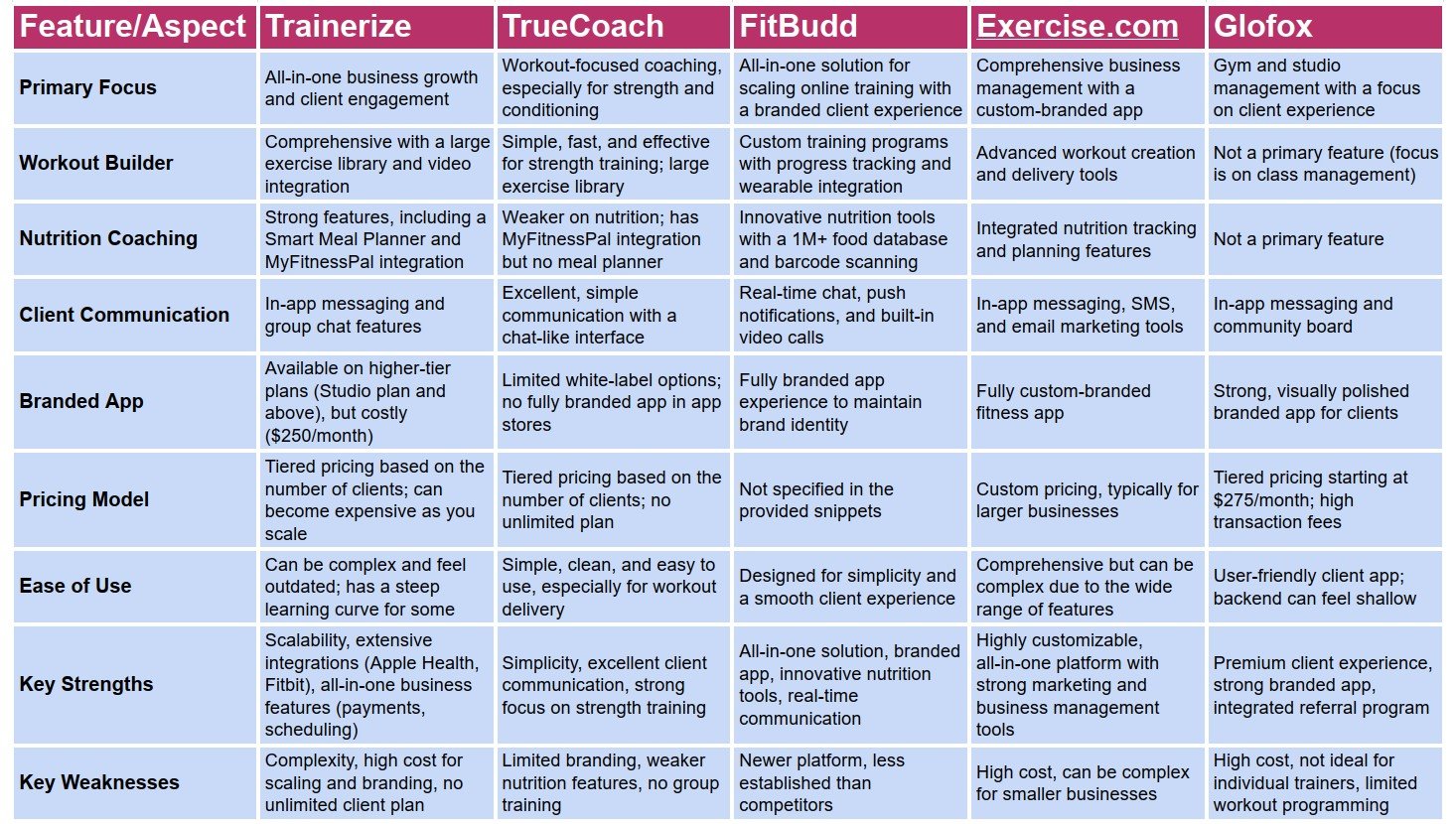
The choice of platform can have a significant impact on a coach’s ability to scale, with different options offering varying features, pricing models, and levels of customization. A thorough comparison of the leading platforms provides the basis of an informed decision that aligns with the specific needs and goals of the business .
Table: Comparison of Top Online Fitness Coaching Platforms (Trainerize, TrueCoach, and Others)
The market is filled with various online fitness coaching platform options, each with its own set of features, strengths, and weaknesses. The table below provides a comparative analysis of some of the top platforms, including Trainerize and TrueCoach, based on information gathered from multiple industry reviews and comparisons.
Social Proof: Client Success Stories
Testimonials are the currency of trust in the fitness industry, transforming skeptical scrollers into paying clients through the power of real transformation stories. Social proof content uses the power of peer influence by showcasing real results achieved by actual clients.
Build credibility by showcasing clients who’ve achieved what your prospects want. Share before-and-after photos with detailed narratives about their journey, highlighting struggles they overcame and milestones they reached. Create video testimonials where clients speak directly to camera about their experience working with you. These authentic moments resonate because they’re relatable.
Effective social proof goes beyond superficial results to tell compelling stories about the transformation process. Rather than just showing physical changes, successful case studies highlight the emotional, mental, and lifestyle improvements clients experience. Include specific metrics—pounds lost, strength gained, confidence restored—that prove your methods work.
Don’t just celebrate the dramatic transformations. Feature everyday wins too: the busy parent who finally prioritized themselves, the desk worker who eliminated back pain. Including diverse success stories that represent different starting points, timeframes, and types of progress helps potential clients see themselves in the results. These stories create connection points where prospects see themselves reflected.
Build High-Impact Platform Presence
Your content pillars won’t gain traction without strategic platform selection. Different platforms serve different purposes in your content marketing ecosystem, from discovery to authority-building to community nurturing.
Instagram and TikTok for Discovery
Where do most people discover new fitness content today? It’s overwhelmingly on Instagram and TikTok. These platforms function as discovery engines, with their algorithms designed to surface engaging content to users who haven’t yet followed the creator. These platforms excel at introducing new audiences to fitness instructors through short-form video content that captures attention quickly.
Instagram Reels and TikTok’s algorithm favor fitness content that educates, entertains, or motivates. Post short-form videos demonstrating exercises, sharing transformation stories, or debunking fitness myths. Quick workout demonstrations, fitness tips, myth-busting videos, and behind-the-scenes glimpses into your life tend to generate high engagement rates.
Consistency matters more than perfection—your community values authenticity over polish. The vertical video format and mobile-first consumption patterns require content that works well on small screens with potentially no sound initially. Use trending sounds and hashtags strategically to expand your reach beyond your current followers.
When you engage with comments and participate in fitness challenges, you’re not just building an audience; you’re cultivating a tribe. Regular posting schedules, participation in relevant challenges, and adaptation of popular audio tracks help content gain visibility. However, maintain your expertise and brand voice while adapting to platform trends rather than completely changing your message to chase viral moments.
YouTube for Authority Building
While Instagram and TikTok help you get discovered, YouTube establishes you as an authority in the fitness space. The platform’s integration with Google search makes it invaluable for capturing organic traffic from people actively seeking fitness solutions. When you create longer-form content here, you’re building a library of valuable resources that positions you as the expert your community trusts.
Focus on educational content that solves specific problems. Film detailed tutorials, explain proper form, debunk fitness myths, and share your training philosophy. Long-form content allows you to demonstrate complete expertise through full-length workout classes and in-depth educational videos. These videos become evergreen assets that continue attracting viewers long after you’ve published them.
Well-optimized YouTube content can attract viewers for months or years after publication, providing ongoing lead generation without additional promotion. Optimize your titles and descriptions with keywords your ideal clients are searching for. Video titles should include keywords that potential clients might search for, such as “Complete Beginner Strength Training Program” or “How to Fix Forward Head Posture.”
Create compelling thumbnails that stand out in their feed. Playlist organization helps viewers find related content and keeps them engaged with multiple videos during each visit. Most importantly, engage with comments to foster the connection your audience craves. You’re not just teaching exercises—you’re building a movement people want to join.
Facebook Groups for Community
Facebook Groups transform casual followers into committed community members who show up, engage, and support each other’s fitness journeys. Unlike other social platforms where content reaches audiences algorithmically, Facebook Groups enable direct communication with members who have specifically chosen to join the community.
Create a space where your clients celebrate wins together, troubleshoot challenges, and form genuine connections that keep them motivated. Successful fitness-focused Facebook Groups combine educational content with community support and accountability features. Share weekly workout challenges that encourage members to post progress photos and tag accountability partners.
Host live Q&A sessions where you answer form questions and provide personalized modifications. Pin transformation stories that inspire newcomers and validate long-term members’ efforts. Members can share progress updates, ask questions, and support each other’s goals while you provide expert guidance and moderation.
Your group becomes the digital equivalent of a gym community—members develop friendships, share recipes, and check in on each other’s consistency. This belonging keeps retention rates high and generates authentic testimonials that attract new clients organically. The private nature of groups also allows for more personal sharing and support than public social media platforms typically accommodate.
Build Your Email List with Lead Magnets
Email marketing remains one of your most powerful tools for converting followers into paying clients. Strategic lead magnets, automated sequences, and targeted messaging create a systematic approach to nurturing relationships and driving conversions.
Create Valuable Free Workout Plans
Lead magnets transform casual website visitors into engaged subscribers who genuinely want to hear from you. They serve as the bridge between social media followers and email subscribers by offering substantial value in exchange for contact information. Free workout plans serve as powerful magnets because they deliver immediate value while showcasing your expertise.
Design your workout plans to solve specific problems your ideal clients face. The most successful fitness lead magnets address narrow, specific challenges rather than broad topics. Instead of a generic “beginner workout plan,” consider offerings like “7-Day Home Workout Challenge,” “15-Minute Morning Mobility Routine for Desk Workers,” or “Postpartum Core Restoration Program.” This specificity attracts people with particular needs while filtering out less qualified leads.
Format matters significantly. Create downloadable PDFs with clear instructions, exercise demonstrations, and progress tracking sheets. Include your branding throughout so subscribers remember who helped them succeed. Lead magnet creation should prioritize quality and completeness over complexity. Provide enough value that recipients feel grateful for the free resource while demonstrating the level of expertise available through paid services.
When people experience quick wins from your free content, they’ll trust you enough to invest in your premium offerings.
Design Automated Welcome Sequences
Once someone downloads your free workout plan, what happens next determines whether they become a paying client or forget about you entirely. Automated email sequences nurture new subscribers by delivering consistent value while building relationships that lead to client conversions.
Set up a series of 5-7 emails that deliver immediate value while building trust. The first email should deliver the promised lead magnet immediately while introducing your background and approach. Start with a warm welcome message that includes quick-start instructions.
Effective welcome sequences combine personal storytelling with practical value delivery over multiple emails. Follow up with form tips, nutrition guidance, and success stories from your community. Subsequent emails might share your fitness philosophy, provide additional tips related to the lead magnet topic, and gradually introduce information about paid services.
Each email should feel personal, like you’re coaching them directly. Include soft calls-to-action inviting them to your paid programs, but focus primarily on helping them win small victories. The sequence should feel personal and authentic rather than overly promotional. This nurturing process transforms casual subscribers into committed community members who’ll eventually invest in your premium offerings.
Segment Lists for Personalized Communication
When someone joins your email list seeking yoga flows versus HIIT workouts, they’re telling you exactly what they need—so why send them the same message? Email segmentation enables personalized communication that increases engagement rates and conversion potential by delivering relevant content to specific audience subsets.
Create segments based on fitness goals, experience levels, preferred workout styles, and engagement patterns. Basic segmentation might divide subscribers based on the lead magnet they downloaded, indicating their primary interest area. You’ll speak directly to the strength-training enthusiast who wants muscle-building tips, while the beginner gets foundational support.
Tag subscribers based on which lead magnet they downloaded, courses they’ve purchased, or links they’ve clicked. Advanced segmentation could consider factors like email engagement history, website behavior, or survey responses to create highly targeted communication streams. This data reveals their journey and interests, allowing you to send targeted content that resonates.
Your community members will feel understood when you acknowledge their specific challenges. They’ll open emails more frequently, engage with your content, and ultimately transform from subscribers into loyal clients who trust your guidance. The goal is delivering content that feels personally relevant to each subscriber while avoiding overwhelming complexity in email management.
AI-Powered Platforms Significantly Boost Engagement
Leveraging AI-powered platforms can create personalized fitness content that resonates with your audience and drives significantly higher engagement rates. These tools help you scale your content production while maintaining quality and authenticity.
Interactive Fitness Quizzes with Outgrow and Similar Tools
Interactive fitness quizzes transform passive website visitors into engaged prospects while collecting valuable data about their goals, preferences, and pain points. Interactive content tools are transforming how fitness instructors engage with potential clients by creating personalized experiences that provide immediate value while collecting valuable lead information.
Platforms like Outgrow, Typeform, and Involve.me let you build “What’s Your Fitness Personality?” or “Find Your Perfect Workout Style” quizzes without coding knowledge. These tools are particularly effective because they address the common challenge of finding the right approach among countless options.
Fitness personality quizzes help users identify their ideal workout style, nutrition approach, or fitness goals. A quiz might assess preferences for group versus individual activities, high-intensity versus moderate exercise, and time availability to recommend a personalized training approach. The results provide immediate value while creating natural opportunities to promote relevant services.
You’re not just gathering email addresses—you’re identifying who needs HIIT programs versus gentle yoga flows. The data you collect guides your content creation, email segmentation, and product development. When someone completes your quiz, they’ve already invested time in your community.
The engagement boost from interactive content comes from the personalization and immediate gratification these tools provide. That investment creates psychological commitment, making them significantly more likely to join your programs than random subscribers who simply downloaded a generic guide.
ChatGPT and Jasper AI for Content Generation
AI writing assistants like ChatGPT and Jasper have revolutionized how fitness instructors produce consistent, high-quality content without burning hours at their keyboards. These tools can help generate social media captions, email newsletters, blog post outlines, and workout descriptions while maintaining your unique voice and expertise.
Generate workout descriptions, email sequences, and social media captions in minutes rather than days. These tools understand fitness terminology and can adapt your brand voice across platforms, keeping your community engaged while you focus on training clients.
The most effective use of AI writing tools involves collaboration rather than complete automation. You’re not replacing your expertise—you’re amplifying it. Use AI to draft blog posts about nutrition myths, create personalized workout plans, or brainstorm content themes your audience craves. Fitness instructors can use AI to overcome writer’s block, generate multiple content variations for testing, or create first drafts that are then refined with personal expertise.
The key is editing AI outputs to inject your personality and professional insights. AI tools excel at content repurposing, helping you maximize the value of existing content by adapting it for different platforms and formats. A single blog post about proper squatting technique could be transformed into social media posts, email newsletter content, video scripts, and infographic text.
This efficiency allows you to maintain the authentic connection your followers expect while scaling your content production sustainably.
Start with One Platform and Scale Systematically
The biggest mistake new fitness instructors make is attempting to maintain a presence on every social media platform simultaneously. While the allure of being everywhere at once might seem appealing, spreading yourself too thin across multiple platforms is a recipe for burnout and mediocre results.
Instead, choose one platform where your ideal clients already spend their time and master it completely. Platform selection should consider factors like content creation skills, target audience preferences, and personal comfort levels. Visual learners who enjoy video creation might focus on Instagram or TikTok, while those who prefer written content might prioritize blogging or LinkedIn.
Build genuine connections, understand the algorithm, and create content that resonates deeply with your community there. Once you’ve established a strong presence and consistent engagement, then consider expanding. Systematic scaling involves establishing measurable success metrics on the primary platform before adding additional channels.
This might mean reaching 10,000 engaged followers, generating 50 leads per month, or achieving consistent engagement rates above industry benchmarks. This systematic approach lets you develop platform-specific expertise rather than posting generic content everywhere.
Your audience deserves your focused attention, not divided energy. By concentrating your efforts, you’ll create meaningful relationships and build a loyal community that actually engages with your content and trusts your guidance.
The scaling process should prioritize content repurposing to maximize efficiency. A single piece of cornerstone content, such as a detailed YouTube tutorial, can be adapted into Instagram Reels, TikTok videos, blog posts, email newsletter content, and social media graphics. This approach ensures consistent messaging while reducing the content creation burden as the platform presence expands.
Conclusion
You’ve got the roadmap—now it’s time to execute. The online fitness market’s explosive growth toward $59 billion by 2027 creates unprecedented opportunities, but only for instructors who approach content marketing strategically rather than haphazardly.
Start by identifying your niche and understanding what your audience truly needs. Create detailed buyer personas that go beyond demographics to capture the emotional drivers behind fitness decisions. Set SMART goals that align your content efforts with measurable business outcomes.
Master your three content pillars—educational tutorials, engagement activities, and social proof—to systematically build trust and demonstrate value. Choose one platform that matches your strengths and audience preferences, then scale systematically using content repurposing to maximize efficiency.
Build that email list with valuable lead magnets, nurture subscribers through automated sequences, and segment your communication for maximum relevance. Leverage AI-powered tools to boost engagement and maintain consistency without burning out.
Don’t try to do everything at once. Success in content marketing requires patience, consistency, and strategic thinking rather than quick fixes or viral content hopes. With focused execution and personalized strategies driving deeper connections, you’ll stand out in 2026’s crowded fitness market.
Take action today, stay consistent, and watch your online fitness business transform from just another account in the feed to a thriving community that converts followers into loyal, paying clients.
For further assistance, we offer a done-for-you solution. DFY Content Marketing specializes in helping online fitness instructors build systematic content strategies that attract and convert ideal clients.