
Choosing between HubSpot and Marketo for content marketing isn’t just about features—it’s about whether your team needs streamlined simplicity or enterprise-grade complexity, and the pricing difference might surprise you.
Key Takeaways
- HubSpot excels at unified content creation and distribution through its integrated Content Hub and Marketing Hub ecosystem, making it ideal for marketing teams that want everything in one platform.
- Marketo dominates enterprise-level marketing automation with advanced lead scoring, multi-touch attribution, and sophisticated personalization capabilities that support complex B2B sales cycles.
- Implementation timelines differ dramatically: HubSpot offers streamlined onboarding that can get teams operational within days, while Marketo typically requires weeks to months of setup and training.
- Pricing structures reflect different business models: HubSpot uses transparent seat-based pricing starting at $450/month for Content Hub Professional and $800/month for Marketing Hub Professional, while Marketo employs database-driven costs ranging from $40,000 to $200,000+ annually.
- The choice between platforms depends on whether marketing teams prioritize simplicity and speed-to-market versus advanced automation and enterprise-grade complexity.
Marketing managers face a critical decision when selecting content marketing platforms: choosing between user-friendly integration or sophisticated automation capabilities. This comparison examines how HubSpot and Marketo approach content marketing from fundamentally different perspectives, helping teams identify which platform aligns with their operational needs and growth objectives.
Two Distinct Platforms Built for Different Content Marketing Needs
HubSpot and Marketo represent divergent philosophies in content marketing automation. HubSpot positions itself as an all-in-one solution that consolidates content creation, customer relationship management, and marketing automation within a single ecosystem. This integrated approach eliminates data silos while providing marketing teams with unified visibility across the entire customer journey.
Marketo, acquired by Adobe in 2018, focuses exclusively on marketing automation excellence. The platform excels at orchestrating complex, multi-touch campaigns that span extended B2B sales cycles. Rather than building content management capabilities internally, Marketo integrates deeply with existing enterprise systems like Salesforce and Microsoft Dynamics to create powerful automation workflows.
These architectural differences shape everything from daily workflow efficiency to long-term scalability considerations. Teams seeking rapid deployment and simplified operations gravitate toward HubSpot’s unified approach, while organizations requiring sophisticated lead nurturing and attribution modeling often find Marketo’s specialized capabilities indispensable.
HubSpot’s Content Hub: Unified Content Creation Within the All-in-One Ecosystem
1. Content Hub’s AI-Powered Creation Tools Including Content Remix and Blog Writer
HubSpot’s Content Hub transforms content production through intelligent automation and repurposing capabilities. The Content Remix feature stands as a flagship innovation, converting single pieces of content into multiple formats automatically. Marketing teams can write one blog post and instantly generate social media content, email sequences, landing page sections, and audio files from that source material.
The AI Blog Writer produces SEO-optimized blog posts at scale using advanced language models and keyword research data. Teams provide topic information and target keywords, the AI creates an editable outline, then generates complete drafts. While content requires human refinement to maintain brand voice authenticity, this capability accelerates initial content production significantly.
Brand Voice training ensures consistency across all AI-generated content. The system analyzes existing content to learn tone, style, and vocabulary patterns, then provides real-time suggestions to align new material with established brand standards. This feature proves particularly valuable for teams working with multiple content creators or onboarding new team members who need to match established voice guidelines.
2. Integrated CRM Providing Unified Customer View for Personalized Experiences
HubSpot’s native CRM integration eliminates the complexity of connecting separate systems while providing detailed customer intelligence. The platform automatically tracks every interaction across website visits, email engagement, social media activity, and content consumption to build detailed contact profiles without manual data entry.
Smart Content uses this unified data to personalize website sections based on visitor attributes. Marketing teams can display different content blocks, images, and calls-to-action based on lifecycle stage, geographic location, industry, or previous engagement history. This personalization occurs in real-time without requiring separate audience segments or complex configuration.
Personalization tokens insert CRM data directly into emails, landing pages, and web content to create tailored experiences at scale. The system pulls information like company names, job titles, recent purchases, or custom properties to make communications feel individually crafted while maintaining automation efficiency.
3. Visual Workflow Builder Simplifying Real-Time Marketing Automation
HubSpot’s workflow builder uses drag-and-drop interfaces that make complex automation accessible to non-technical users. Marketing teams can create sophisticated nurture sequences, lead scoring systems, and multi-channel campaigns through visual programming rather than code-based logic.
Professional plans include 300 workflows with unlimited branching capabilities, while Enterprise accounts receive 1,000 workflows. Each workflow supports conditional logic, delays, CRM updates, and integration triggers that respond to behavioral data in real-time.
The system tracks workflow performance through detailed analytics that show conversion rates at each step, helping teams optimize automation sequences based on actual engagement data rather than assumptions about customer behavior.
4. Omnichannel Distribution Across Web, Email, and Social Platforms
Content distribution within HubSpot spans multiple channels through centralized campaign management. Teams can publish blog posts, schedule social media content, deploy email sequences, and update landing pages from a single interface while maintaining consistent messaging across touchpoints.
The platform includes native hosting for video and podcast content with engagement tracking that flows directly into the CRM. This integration enables teams to identify which multimedia content drives the highest-value leads and optimize production accordingly.
Social media scheduling supports Facebook, Instagram, Twitter, and LinkedIn with platform-specific optimization features. The social calendar provides visual campaign oversight while automated posting maintains consistent brand presence without manual intervention.
Marketo: Enterprise Marketing Automation with Advanced Personalization
1. Lead Scoring Based on Behavior, Demographics, and Engagement Levels
Marketo’s lead scoring system combines explicit information from forms and CRM data with implicit behavioral signals to prioritize prospects with mathematical precision. The platform tracks website navigation patterns, content consumption, email engagement, and social media interactions to assign numerical values that reflect conversion likelihood.
Behavioral scoring monitors actions like whitepaper downloads, pricing page visits, product demo requests, and email click patterns to identify buying signals. Demographic scoring evaluates company size, industry, job role, and geographic location against ideal customer profiles to determine fit quality.
Advanced scoring models support negative scoring that reduces lead values for behaviors indicating disengagement or poor fit. This bidirectional approach helps sales teams focus energy on prospects showing genuine interest while avoiding time investment in unlikely conversions.
2. Marketo Measure for Multi-Touch Attribution and Customer Journey Optimization
Marketo Measure (formerly Bizible) provides enterprise-grade attribution modeling that tracks every customer touchpoint from initial awareness through closed deals. The platform supports six attribution models including First Touch (credits the first interaction), Lead Creation (credits the touchpoint that created the lead), U-Shaped (splits credit between first touch and lead creation), W-Shaped (credits first touch, lead creation, and opportunity creation), Full Path (distributes credit across all touchpoints), and Custom Model approaches.
This attribution enables marketing teams to understand which content pieces, campaigns, and channels contribute most significantly to revenue generation. Rather than relying on last-touch attribution that typically credits bottom-funnel activities, Marketo Measure distributes credit across the entire customer journey.
Revenue attribution reporting connects marketing activities directly to closed-won deals, helping teams demonstrate ROI and optimize budget allocation based on actual revenue impact rather than vanity metrics like clicks or impressions.
3. AI-Driven Predictive Content Recommendations and Audience Targeting
Predictive Content, powered by Adobe Sensei AI, automatically discovers and tags content assets for intelligent recommendations. Machine learning algorithms analyze user behavior patterns, preferences, and interaction history to suggest relevant content that increases engagement likelihood.
The system delivers recommendations through website recommendation bars or embedded content within emails. Dynamic personalization adjusts headlines, images, and calls-to-action based on individual user profiles while A/B testing optimizes recommendation performance continuously.
Predictive Audiences use artificial intelligence to identify leads most likely to attend events, register for programs, or convert based on historical patterns. Marketing teams can create smart lists that automatically include prospects matching high-probability criteria, enabling proactive outreach to qualified opportunities.
4. Native Integration with Salesforce and Microsoft Dynamics
Marketo provides deep, bidirectional integration with Salesforce and Microsoft Dynamics that synchronizes lead data, opportunity information, and activity history in real-time. This native connectivity ensures marketing and sales teams work from identical data sets without manual updates or system delays.
The integration enables sophisticated lead handoff processes where marketing-qualified leads automatically flow to sales with complete engagement histories. Sales activities and opportunity updates sync back to Marketo to inform future marketing campaigns and attribution models.
Campaign influence tracking connects marketing touches to sales outcomes, helping teams understand which campaigns accelerate deal velocity and which content types sales teams find most effective during prospect conversations.
Platform Usability: Quick Setup vs. Weeks-to-Months Implementation
HubSpot’s Streamlined Onboarding Process
HubSpot’s onboarding emphasizes speed and simplicity through guided setup wizards that help teams become operational within days rather than weeks. The platform includes its own CRM, eliminating integration complexity while providing step-by-step walkthroughs for contact imports, email setup, and basic automation configuration.
New users encounter interactive tutorials and contextual help throughout the interface, making feature discovery intuitive for marketers without extensive technical backgrounds. The visual workflow builder and drag-and-drop editors reduce dependency on IT support or specialized training.
Most teams achieve basic functionality within their first week, with advanced features becoming accessible as users gain experience. This progressive disclosure approach prevents overwhelming new users while ensuring advanced capabilities remain available when needed.
Marketo’s Variable Implementation Timeline Based on Requirements
Marketo implementation typically spans several weeks to months depending on organizational complexity and integration requirements. The platform requires technical setup including DNS configuration, CRM integration, custom field mapping, and API connections that often necessitate IT department involvement.
Adobe Experience League recommends HTML experience and IT assistance for completing initial setup steps. The modular interface, while powerful, presents a steeper learning curve that benefits from formal training through Marketo University.
However, this complexity enables sophisticated customization that supports enterprise-level marketing operations. Organizations with complex lead scoring requirements, multiple business units, or extensive personalization needs find this implementation investment worthwhile for long-term operational efficiency.
Pricing Models: Tiered Seat-Based vs. Database-Driven Enterprise Costs
1. HubSpot’s Multi-Tier Seat-Based Pricing with Varying Features
HubSpot employs transparent seat-based pricing where teams pay for users with full platform access while view-only permissions remain free. Content Hub Professional starts at $450 monthly with three core seats included, providing AI-powered content creation, SEO tools, and workflow automation without onboarding fees.
Marketing Hub Professional costs $800 monthly (annual billing) with 2,000 marketing contacts and three seats included, but requires a $3,000 onboarding fee. Enterprise tiers ($1,500-$3,600 monthly) add predictive lead scoring, advanced attribution, and multi-site management capabilities.
Additional costs scale with marketing contacts and extra seats. Marketing contacts (those receiving promotional emails or ad targeting) can be added in increments ranging from $250-$100 monthly depending on tier and volume.
2. Marketo’s Database-Size Driven Costs
Marketo uses customized pricing based on database size, feature requirements, and support levels without publicly displayed rates. Annual contracts typically range from $40,000 for basic implementations to $200,000+ for enterprise deployments with advanced features.
All known records count toward database limits, including leads, contacts, and accounts with any identifying information. This differs from marketable contacts, potentially creating higher costs for organizations with large customer databases or extensive prospect lists.
Database growth requires careful management since contact volume directly impacts pricing. Regular data hygiene practices including duplicate removal, outdated record purging, and segmentation strategy become critical for cost control.
3. Total Cost Including Implementation, Training, and Ongoing Management
HubSpot’s total cost of ownership includes platform subscriptions, onboarding fees for higher tiers, and potential consulting assistance. Most teams can achieve self-sufficiency with internal resources, though Solutions Partner implementation provides accelerated deployment for complex scenarios.
Marketo’s implementation costs extend beyond platform licensing to include technical setup, CRM integration, user training, and ongoing optimization. Organizations typically invest additional resources for Marketo-certified consultants or dedicated marketing operations personnel to maximize platform utilization.
Ongoing support requirements differ significantly. HubSpot teams often manage platform evolution internally, while Marketo implementations benefit from specialized expertise to handle advanced automation, integration maintenance, and performance optimization.
Choose HubSpot for Simplicity, Marketo for Enterprise-Level Complexity
Platform selection ultimately depends on organizational priorities and operational capacity. HubSpot delivers content marketing capabilities through an integrated ecosystem that prioritizes ease of use and rapid deployment. Marketing teams seeking unified content creation, CRM integration, and straightforward automation find HubSpot’s all-in-one approach eliminates tool sprawl while providing clear visibility into campaign performance.
Marketo excels for organizations requiring sophisticated marketing orchestration at enterprise scale. The platform’s advanced lead scoring, multi-touch attribution, and deep CRM integration support complex B2B sales cycles with multiple stakeholders and extended buying journeys. Teams with dedicated marketing operations resources and commitment to advanced personalization achieve exceptional results through Marketo’s specialized capabilities.
Budget considerations extend beyond licensing costs to include implementation complexity, training requirements, and ongoing management resources. HubSpot’s transparent pricing and streamlined onboarding reduce total cost of ownership for many organizations, while Marketo’s enterprise-grade features justify higher investment for teams requiring advanced automation capabilities.
For guidance on an optimal content marketing strategy, DFY Content Marketing can help marketing teams make informed decisions.
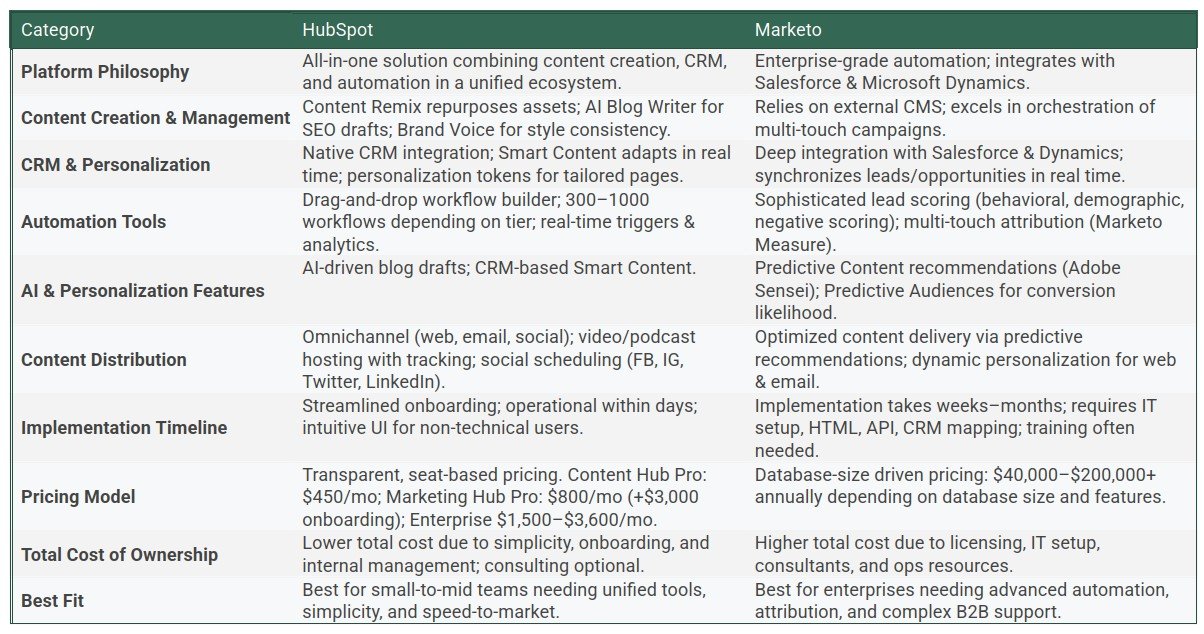
Features and Pricing Comparison Table
(click to enlarge)